The Effects of Art With at Risk Youth Peer Reviewd
Introduction
Although inquiry on the psychological benefits of arts education is expanding quickly, problems remain in the ways in which such research is presented, publicized, and used to inform educational programs and policy. Chief among these is a tendency for discussions to focus on the benefits of "arts pedagogy," equally though all arts education were a monolithic activeness with a singular pathway to uniform benefits. Here, nosotros argue that our field must move beyond such broad claims virtually the impact of "arts teaching" to delineate the effects of particular forms of arts education, offered in certain contexts, on specific domains of children's socioemotional development, a broad construct that encompasses identity formation, self-regulation, and interpersonal skills (Collaborative for Academic, Social, and Emotional Learning, 2021) and one that research increasingly suggests is fostered by many arts education experiences (see, for instance, Farrington et al., 2019).
This specificity is essential for three reasons. Outset, the field has by now progressed to a point that merely demonstrating an association between some broad characterization of arts education (due east.g., "theater didactics") and some domain(s) of children's socioemotional development (due east.chiliad., empathy) is unlikely to found a meaningful advance in our understanding of the relation betwixt arts education and kid development. In gild to continue to build a scientific understanding of the potential function of arts education in children's socioemotional development, we must formulate and examination more precise hypotheses that link a detail form of arts didactics offered in a given context to a specific domain of that evolution. Only when all three of these terms – educational feel, context, and domain of socioemotional development – are adequately defined is it possible for researchers to reconcile the results of dissimilar studies and make informed hypotheses nearly whether the arts education feel that they are studying volition yield a similar pattern of findings.
2d, if arts educators want to contribute to burgeoning efforts to foster children'south socioemotional development, they must design and implement programs that can attain this goal. This is far more likely when programs are intentionally designed around a plausible theory of change that links program activities to specific domains of children's socioemotional development, and that provides guidelines for implementing a programme with allegiance beyond unlike participants, sites, and contexts. The alternative – offer an ill-divers program and hoping for some unspecified socioemotional do good to accrue – is unlikely to accomplish results.
Third, just as a programme is more than likely to achieve its aims when built around a plausible theory of change, so besides are initiatives or efforts comprised of many organizations working in concert. Given that arts instruction initiatives are often supported with public funds, educators and policymakers must be convinced of the initiatives' potential prior to implementation and connected efficacy thereafter in order to provide back up. Delineating the specific benefits of arts pedagogy initiatives to children'due south socioemotional evolution aligns the expectations for these initiatives to the activities they offer and ensures that claims for these initiatives do not outpace the show for their likely effects.
These reasons could merely as easily be cited to back up an argument for a more than thoughtful arroyo to understanding the benefits of the arts for children'due south cognitive development, rather than their socioemotional development. Indeed, the purlieus between cognitive and socioemotional development is often quite permeable: there is a cognitive component to about socioemotional skills and a socioemotional component to most cognitive abilities. Moreover, the effects of an arts educational activity experience on a detail aspect of children'south socioemotional development (due east.g., empathy) may exist mediated past changes in children'southward cerebral processes (due east.g., theory of mind).
Notwithstanding, this paper focuses on arts educational activity and children'due south socioemotional development for 2 reasons. Beginning, it is an area of burgeoning research interest, with an always-increasing number of studies yielding findings that are now in need of conceptual organization. Second, it is also an area of emergent interest among educational practitioners and policymakers, and, as such, the socioemotional benefits of the arts have increasingly been cited in arguments that an educational activity in the arts is an integral part of every child'due south development (run into, for case, the United nations' Convention on the Rights of the Child, Articles 28 and 29). That said, many, if not all, aspects of our argument would apply equally well to research that seeks to empathize the furnishings of arts education experiences on children's cognitive evolution, and we would encourage researchers whose work focuses on arts pedagogy and cognitive development to employ an approach similar to that which we outline here.
The remainder of this paper is divided into two sections. The starting time section reviews three aspects of any arts pedagogy activity or program that must be considered to effectively delineate its benefits on children's socioemotional development: (1) a sufficiently differentiated definition of the arts education activity; (2) the firsthand context in which that activeness occurs; and (3) the broader ecological or environmental context in which it occurs besides. The second section proposes how researchers might frame hypotheses nearly the likely effects of a specific arts education intervention on children's socioemotional development using the example of the New Victory Theater's Schools with Performing Arts Achieve Kids (SPARK) program – a theater program offered to students in the upper uncomplicated grades.
Delineating the Benefits of Arts Education
Toward a Differentiated Definition of Arts Educational activity
The first step in formulating precise hypotheses nigh the socioemotional benefits of arts education is to develop a differentiated definition of arts teaching activities and programs. While it may seem obvious that participation in a Ballet course is different than participation in a jazz music ensemble, every bit mentioned to a higher place, "arts education" is often treated as a monolith. Withal, there are non only distinctions both between art forms, but also within individual fine art forms every bit well (e.chiliad., genre or tradition). Information technology is an open question equally to whether these differences crusade variation in outcomes, and which elements of an arts course drive causal changes. Any researcher must decide at the outset, for example, whether they are interested in the holistic effects of a theater class, with its curriculum decided by experts in theater and its activities shaped over many years (due east.g., Goldstein et al., 2017), or whether they would rather specify and isolate effects of an acting course via well-matched control groups and strictly-specified activities. Regardless, when discussing and reporting whatsoever research, details matter, as they define the specific opportunities for socioemotional development different arts education experiences and programs afford children (Gibson, 1979; Jenkins, 2008). These include, for instance, whether the arts activities were experienced as audience or performer, and whether the arts practice was informed by classical forms, modern techniques, or mail-modern experimental methods.
2 reasons such differentiation is non regularly undertaken in inquiry reporting is because of the sheer number of ways in which arts activities can be categorized, and a lack of knowledge of which of these categorizations matters for children's evolution. To begin, there is the domain of an arts education experience: (1) visual arts, including painting, drawing, sculpture, and collage; (two) dance, including ballet, jazz, tap, hip-hop, modern, and choreography; (3) theater, including improvisation, classical, modern, experimental, and musical theater; and (4) music, including orchestral, pop, jazz, band, and improvisation, performed either instrumentally or vocally, as well as media. This, of course, is a curt and introductory list of possibilities and subgenres. Some scholastic curricula also include digital media or culinary skills in the arts, or separate out creative writing such equally poesy, drama, or fiction into the arts, while others include creative writing genres in drama or English classes.
It is of import when thinking nigh the contextual effects of different arts domains on outcomes to keep in mind that art forms are often combined in practice, professional presentation, and occasionally in the classroom. Poems are set to music. Staging an opera requires music, dance, interim, and make up, costumes, and designed sets. Thus, while arts educational activity experiences tin can exist categorized in ways that reflect the disciplinary boundaries of the arts themselves, the boundaries betwixt those experiences may be more or less permeable than those encountered in the arts the arts themselves. Moreover, elements of the arts may be integrated into educational experiences that are primarily intended to convey cognition about subjects exterior of the arts, such as when the visual arts are used to teach geometry or when theater is used to enliven history lessons (Hardiman et al., 2014; The Kennedy Center, 2020). While complex, studying how teachers carve up and combine artistic domains will all-time let researchers to approximate both the intricacies of existent-world exercise and the rigor necessary to grade conclusions about how the arts affect socioemotional evolution.
Each domain of the arts has not-mutually exclusive characteristics which can specify furnishings. Music, theater, and trip the light fantastic are generally interpretative and collaborative. Musicians, dancers, and actors can perform solo or work in ensembles of many sizes, learning and interpreting a composer's, choreographer'due south, or playwright's piece of work. Visual artists, in contrast, tend to work more by themselves, generating textile. However, visual artists tin work in collectives, and music, dance, and theater all have the possibility of generating and/or improvising work equally part of written report. In fact, virtually theater classes begin with an improvisational warm up, and utilize the generation of text and beliefs throughout rehearsal processes. Music and dance both rely on rhythm; theater and the visual arts incorporate figural and representative elements. Inside each domain and genre, an additional element to consider is the time menstruum or form on which the course is focused. Any class in these arts domains could focus on Western or Eastern classical works, the modern artistic revolutions of the 19th and 20th centuries, or electric current experimental work. Like any area of report that continues to be informed by its own history, arts classes' foci in time bear on the type of work the student will engage in, their freedom of form and estimation, and the rules they "should" follow. Whether these differences lead to distinct outcomes is unstudied at this point.
Similarly, there may be fundamental differences when a student actively participates in the creation of art, theater, trip the light fantastic toe, or music, compared to when they are simply in the audience or observing. While there is some evidence to suggest that both watching (Greene et al., 2018) and participating (Goldstein and Winner, 2012) in theater in middle babyhood positively affects empathy, more than studies are needed to replicate both effects, and this blazon of convergence may non concord for other art forms. Painting or walking through a museum, playing a violin or sitting in a concert hall, hours of concrete practice or watching a Ballet are such significantly dissimilar behavioral and psychological activities, it would be very surprising if they caused the same effects.
One starting bespeak for conceptualizing the real implications for social and emotional learning beyond and within art domains is past investigating the habits of listen fostered and supported by each. Habits of mind are cerebral patterns – domain general ways of thinking about problems, framing the world, and guiding behaviors (Perkins et al., 1993). Intensive studies on habits of listen are well-established in the visual arts (Hetland et al., 2015), with similar studies recently conducted in music (Hogan and Winner, 2019) and theater (Goldstein and Young, 2019). The similarities among art forms, such every bit their artful and expressive components, have led some theorists to work toward a unification of the psychological components of art forms (Brown, 2018), but practitioners may or may non agree. To this signal, both visual arts and music have been institute to utilize the habits of heed of persistence (i.eastward., continue going at exercise and working through a problem); imagination (of what changes in a musical functioning or visual stimuli may look like); and expression of ideas and meaning (Hetland et al., 2007, 2015; Hogan and Winner, 2019). But music may focus on building and creating ensemble while visual arts engage the use of careful observation and perception.
Finally, the "same" artistic activity can occur in many forms (Greeno, 2006). To take an example from theater education, a child may report his grapheme, memorize lines, rehearse scenes, informally perform for peers, or perform in a full-fledged production before an audience. Each of these activities has unlike experiential elements and immediate contexts, and, equally such, may inculcate different states of arousal and incur different consequences. Thus, if researchers seek to build the evidence base for incorporating theater pedagogy into schoolhouse curricula and youth programming, it is vital to empathize which activities in which contexts have a measurable impact on what domains of socioemotional development among which children (Holochwost et al., 2018).
The Role of Context
The Immediate Context
Defining an arts education action or program by differentiating information technology in terms of its domain and characteristics is an essential first step toward formulating hypotheses almost that action or program's socioemotional benefits. The side by side pace is to consider the immediate context in which that activeness or program occurs. The purpose of this is to provide a deeper understanding of where, for whom, by whom, and how a specific arts didactics experience was offered. For example, a performing arts residency programme could play out quite differently in an arts magnet elementary school and an elementary schoolhouse that lost its arts programs a decade ago. Similarly, the impact of a performing arts program might exist markedly different if classroom teachers are viewed chiefly as behavior managers and facilitators or if they are active participants in professional evolution sessions designed to transfer performing arts strategies to their daily instruction. Taken together, information on the immediate context helps to define the environment/ecology in which a program occurs, who is an active participant, and how the plan was implemented.
One essential parameter of the immediate context of an arts teaching program or activity is the specific institutional setting in which that activity occurs. A proficient bargain of arts didactics occurs in schools, simply arts education also takes place in many other settings, from community arts organizations to cultural providers to children'due south homes. Each of these settings has a detail arts learning profile, a configuration of characteristics that defines that setting as an immediate context for arts learning. For programs that occur in schools, elements of this contour include the adequacy of the physical space made available for the program, the level of support offered to the programs by classroom teachers and administrators, the history and prominence of arts education at the school, and whether arts didactics is function of the curriculum for all students or whether it is made available but to students who meet certain academic or behavioral standards. Merely knowing that a pupil participated in a programme of music education at their school is insufficient; the arts learning profile of a school with no dedicated practice or functioning space and a single, itinerant music instructor could not be more different than that of a well-resourced arts magnet school.
Another key parameter is whether there is someone who guides or directs the arts instruction plan or activity. While some arts education experiences may exist self-directed, even an plain contained learning experience such equally roaming a museum exhibit is guided by curatorial decisions and placard texts. However, many arts education experiences feature a more prominent guide in the form of a teacher or teaching artist, and in these cases that teacher's characteristics become important aspects of the immediate context of arts educational activity (Diamond, 2015). These may include the teacher's personal characteristics (e.g., gender and indigenous identities), training (both as an creative person and an educator, including admission to and use of professional evolution), their feel (once more, as an artist and educator in general, but also as arts educator in comparable settings), and their part in the institutional setting (e.g., total-time faculty, itinerant faculty, or invitee artist).
Finally, there are the characteristics of the program or action as delivered in exercise. As Diamond and Ling observed, "the 'same' program or intervention tin can exist administered differently by dissimilar individuals," and the benefits of whatsoever program to children'south socioemotional development will exist determined past children'southward experience in that program equally it is delivered to them (Diamond and Ling, 2020, p. 366). The overall quality of that experience will be defined largely by its process quality (Zaslow et al., 2010), or the patterns of interaction between teacher or education artist and kid.
Studies of early education take consistently revealed that teachers' sensitivity when interacting with children is the principal determinant of whether children derive benefits from early on instruction programs (Burchinal et al., 2000; Melhuish et al., 2015). Similarly, sports and able-bodied enrichment programs take been found to exist nigh beneficial for children when coaches refrain from negative behaviors in their interactions with children (such as embarrassing children) and instead exhibit sensitive behaviors such as offer praise and encouragement, and emphasizing teamwork and enjoyment (Smoll et al., 1993; Smith and Smoll, 1997). Indeed, the benefits children derive from any arts instruction programme will exist contingent upon their date in that program, and engagement is based, in part, on enjoyment (Ericsson et al., 2009).
Even a very high-quality plan must exceed some minimal threshold of dosage in order for it to yield benefits to children's socioemotional development. Dosage may be defined by the frequency and elapsing of the plan or activeness across two time scales (minutes per experience and time between the first experience and the concluding). The dosage of arts educational activity experiences ranges widely from a single field trip to see a operation to daily didactics that spans the course of babyhood. All else being equal, higher dosage of an arts education programme or experience would be expected to predict greater benefits to socioemotional development, but only when that program or experience clears some minimal threshold for dosage.
The Ecological or Environmental Context
As the prior department makes clear, arts education activities and programs are not untethered abstractions; they happen in a given institutional setting with a unique arts learning profile, and are delivered according to a particular model (which may include the presence of a teacher) at a detail dosage. Moreover, the immediate context in which arts education activities and programs occur is nested within a broader ecological or environmental context.
The most of import component of this broader context is the child or children who are being educated, without whom whatever arts educational activity activity or programme cannot occur. The characteristics or features internal to the student or students are, therefore, a key aspect of ecological or environment context in which arts education occurs. Theoretically, almost any child gene could influence the potential for an arts education activity or program to do good a particular domain of children's socioemotional development. Simply some of those factors have proven most probable to accept an consequence in the greatest number of instances, beginning with the factors that are internal to the student.
Among these factors, age or developmental stage may be the almost important influencer beyond the widest assortment of situations, due to the trajectories of different domains of socioemotional evolution. These trajectories influence how sensitive or malleable these domains are when a kid participates in a particular arts education program or feel. Consider the example of self-concept. Fifty-fifty very young children take a concept of themselves; however, among young children self-concept is very broad and general. As children age, self-concept becomes increasingly nuanced. By middle childhood, children reliably differentiate betwixt their self-concept with respect to academics and their cocky-concept in athletics; by adolescence, they see themselves differently in the context of different bookish subjects (Marsh and Ayotte, 2003; Marsh et al., 2018).
As a result, an arts teaching program designed to enhance bookish cocky-concept amidst preschoolers could not reasonably be expected to achieve that aim, for the simple reason that children at this historic period practice not have an bookish self-concept to raise. All else being equal, a programme that targeted academic self-concept among adolescents would be more likely to succeed, if its pattern and implementation reflected not just the trajectory of self-concept beyond adolescence, simply also the ways in which that trajectory, combined with the relative malleability or recalcitrance of different aspects of self-concept, rendered those aspects targeted the program more or less open up to change. Beyond different areas, self-concept in adolescence generally follows a curvilinear trajectory, in which cocky-concept is more positive as children enter adolescence, becomes more negative equally adolescence proceeds, and and so recovers equally it ends. Depending when during adolescence an arts teaching program occurred, it might be expected to take different effects, though the precise nature of those effects would depend on whether more than positive or more negative self-concept would be expected to constrain or promote the program'due south potential benefits.
Other particularly salient child factors include gender and racial/ethnic identity. Returning to the example of cocky-concept, a meta-analysis found that schoolhouse-aged males exhibited slightly college academic self-concept scores than females (Wilgenbusch and Merrell, 1999). However, this overall divergence masked the fact that this departure held only for academic self-concept with respect to mathematics; where English language linguistic communication arts was concerned, females reported college levels of cocky-concept (Stetsenko et al., 2000; Kurtz-Costes et al., 2008). Hence, expectations for arts education to benefit children'south self-concept may have to exist conditioned on both gender and the specific area of academic self-concept (hither, math vs. English language) that a program sought to change.
Of course, while nosotros may seek to isolate the influence of different child factors on socioemotional development in our enquiry designs (e.thou., by belongings different factors abiding), any number of idiographic perspectives (e.g., social identity theory) reveal that within any particular child, these factors occur together (Sellers et al., 1998). That is, a child is not merely an adolescent, but a female adolescent (and many other things likewise). The intersection of these factors volition jointly impinge upon the effects of any arts education plan on that child'south socioemotional evolution. For example, the magnitude of the gender deviation in bookish self-concept is 3 times larger in centre childhood (in males' favor) than it is in adolescence (Wilgenbusch and Merrell, 1999).
Moreover, the influence of these factors will in turn be affected by elements of the developmental ecology that are external to the child. Near salient among these is the kid'south family. Many aspects of the family accept been linked to children's socioemotional development, from family unit structure (Lee and McLanahan, 2015; Bzostek and Berger, 2017) to patterns of interaction between parents and children (Bridgett et al., 2015). Other family factors that take received far less attention, such as whether there is an artist in the firsthand or extended family, may be particularly salient influences on whether arts educational activity benefits children's socioemotional development.
One level removed from the family are the elements of the developmental ecology that contain Bronfenbrenner's exosystem: the child's peer grouping, schoolhouse, and neighborhood (Bronfenbrenner and Morris, 2006). Each of these elements may also influence the bear on of arts education of children's socioemotional evolution, either directly or by impinging upon levels of the ecology that are more than proximal to the child. For example, a lower-income family may reside in a neighborhood comprised of families with various incomes, or they may reside in a neighborhood of concentrated disadvantage. While the social comparison factors (Festinger, 1954) that may back-trail living in a mixed-income neighborhood should not be overlooked, growing up in an surface area of full-bodied disadvantage exerts a direct and tangible effect on children'due south socioemotional development, above and beyond the effects of familial socioeconomic status (Carpiano et al., 2009; May et al., 2018). All the same, full-bodied disadvantage may likewise exert an indirect effect on the benefits of an arts education program through its furnishings on child-level factors, by, for example, limiting a child's admission to arts education and thereby restricting their prior experience in the arts.
Effigy ane summarizes immediate and broader contextual factors discussed in a higher place that may promote or constrain the benefits of arts instruction programs or experiences for children's socioemotional evolution. While this effigy includes the factors discussed in the text, it is not intended to exist an exhaustive list of all firsthand and broader contextual factors that may impinge upon the benefits of arts education programs or experiences.
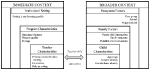
Effigy 1. Graphical summary of immediate and broader contextual factors that may promote or constrain the benefits of arts education programs or experiences on children's socioemotional development.
Formulating Hypotheses
Once a differentiated definition of a item arts education experience or program has been established and the immediate and broader contexts in which that experience of program have been considered, the final step in formulating a hypothesis is to link that experience or program, as information technology occurs in those contexts, to a particular domain of children's socioemotional development. Socioemotional development is typically divers quite broadly every bit "the process through which children and adults understand and manage emotions, prepare and achieve positive goals, feel and evidence empathy for others, establish and maintain positive relationships, and brand responsible decisions" (Collaborative for Academic, Social, and Emotional Learning, 2021). This broad definition encompasses many distinguishable domains of development, including theory of mind, empathy, compassion, sympathy, emotion understanding, and self-regulation, to proper name a few. The claiming is to use theory and prior research, together with the definition of the arts didactics experience or program and knowledge almost the contexts in which it occurs, to predict which domains of socioemotional development are almost likely to exist fostered by that feel or plan. In the residual of this paper, we use the example of the New Victory Theater's SPARK Program to illustrate how this may be accomplished, so provide a brief clarification of a research projection designed to exam the resulting hypotheses.
An Illustrative Example: the New Victory Theater's Spark Program
A Differentiated Definition of the SPARK Program
The New Victory Theater'southward SPARK plan was designed to innovate the functioning arts every bit a core element of the curriculum in schools without opportunities for arts education. The program was based effectually three performances that third-grade students attended over the course of a single school twelvemonth, paired with 15, weekly, in-course workshops that were led by teaching artists (run into firsthand context below). These performances ranged from new plays and theatrical adaptations of existing stories (e.g., Mr. Popper'due south Penguins) to less narrative, performances like circus arts productions and trip the light fantastic revues. Over the course of the year, students saw a balanced slate of productions, including 1 narrative drama, i circus arts production, and one performing arts revue. Regardless of genre, these productions featured many performers who were people of colour playing major roles, and the content of the productions drew on the artistic and performance traditions of many cultures.
In-class residency sessions focused on instruction students information and vocabulary related to the productions they would see and the human lessons those performances embodied. For example, prior to seeing the functioning of the circus arts product, Mother Africa students learned almost the varied African origins of the performers and the long years of daily practice that they spent gaining the circus skills they performed in the show. The residencies also featured activities closely related to the performances students would come across. For instance, before going to see a circus arts performance, students learned how to perform elementary tricks like scarf juggling and plate spinning. Throughout each workshop session, teaching artists taught many interpersonal skills, including subtle ones such as not laughing or teasing when a peer made a fault or suffered a setback. Teaching artists would oftentimes recall a scene or situation from one of the narrative productions (e.g., The Velveteen Rabbit) and ask students to have the perspective of dissimilar characters, articulating those characters' words and internal thoughts.
According to our differentiated definition, this was a theater program, but i that featured functioning arts rather than theater lonely. The predominant genre of works presented was modern, rather than historical or experimental, and many of the productions, as well as many of the activities featured in the workshops emphasized the man and ensemble nature of theater. Students' participation in the plan was multimodal: for the portion of the programme in which they attended productions, students were members of the audience. However, students were besides active participants during the residencies, contributing to generative theatrical and circus functioning activities (rather than scripted activities).
The Immediate and Environmental Contexts of SPARK
As described higher up, the immediate context for an arts education program or activity is comprised of the specific institutional setting with its unique arts learning profile, the presence of a teacher and their characteristics, and the dosage of the experience. In the instance of SPARK, there were two institutional settings for the plan: the theater, where students attended the iii productions, and their classrooms, where the residencies took place. The New Victory Theater is a celebrated venue that was transformed into a children's theater in the mid-1990s. Information technology is located on Broadway, in the heart of New York City'southward theater commune. Information technology is widely regarded as one of the premiere children'southward theaters in the world, and is especially well-known for presenting complex works to immature audiences. For many years, the theater has run a program that recruits immature people of color as ushers in the theater, offering them paid employment while training them for careers in the performing arts.
The children who participated in the plan were in 1 of iv classrooms (all in a unmarried grade) at an elementary school that had been identified by the New York Metropolis School District every bit underperforming. The school had no arts teachers on its faculty (either full or part-time) and was non being served past whatever other customs-based arts education partners. Nonetheless, schoolhouse administrators were interested in using the arts equally a strategy to appoint students and amend the overall performance of the schoolhouse.
The residency sessions were led by pairs of teaching artists (TAs) who were actors and performers working in New York Metropolis. In a number of cases, these TAs were working in other productions while the residencies were in progress; one TA was featured in the Broadway production of The Lion King; another was in the touring production of the Bluish Human Group (as one of the Blue Men). In addition to the training they received when they were hired to be part of the SPARK program, TAs attended a series of professional person development workshops presented by the New Victory Theater over the course of the program year.
The residency sessions were delivered during the school day, and mostly during English arts instruction. The same pair of TAs was assigned to the same classroom(due south) throughout the school twelvemonth. Classroom teachers and any paraprofessional remained in the classroom during the residency sessions, though their levels of involvement varied considerably. To foster a closer working relationship with the classroom teachers, the New Victory Theater hosted 3 teacher workshops over the class of the school year. The sessions lasted a full grade session (approximately xl min) and xv sessions were held betwixt October and May. These parameters of the immediate context are summarized in Table 1.

Table 1. Definitional and contextual parameters of an arts didactics experience.
In the year that we worked with the program, the children who participating in information technology were in third grade. Students in fourth class comprised a comparison group, and though these students attended one operation at the theater, they did not attend the other ii, nor did they receive the in-class residency. Across these ii groups, approximately 60% of the students were female; about all children who attended the schoolhouse were of color (twenty% Black and 76% Hispanic). Over 90% of the students who attended the school received complimentary or reduced-price lunch, and the school is located in an area of concentrated economical disadvantage (57% of families with children in the zero lawmaking in which the school is located were living in poverty).
Hypotheses About the Program's Effects
We predictable that participating in the SPARK program would confer benefits across a number of domains of socioemotional development. For purposes of analogy, we will focus on how we formulated hypotheses nigh the potential for the plan to foster students' social awareness and relationship skills.
We divers social awareness and relationship skills as the abilities to have others' perspective, to sympathise with them, and to class positive relationships with their peers. On the footing of prior enquiry, we hypothesized that participating in SPARK would be associated with an enhanced capacity to take others' perspectives (Goldstein et al., 2013; Greene et al., 2018), higher levels of empathy (Goldstein and Winner, 2012), and more positive peer relations (DICE Consortium, 2010). Given that previous research has demonstrated the potential for attending a single theatrical performance to improve aspects of children's perspective-taking abilities (Greene et al., 2018), we acknowledged that students assigned to the comparison group might exhibit improvements over baseline in this domain. However, we anticipated that the opportunity of handling group students to attend multiple productions and participate in the residencies would lead to yet greater gains.
We and then refined this hypothesis in lite of the differentiated definition of the SPARK plan and both the firsthand and broader contexts of the program. We anticipated that three specific aspects of the program might dilate its capacity to foster students' social awareness and human relationship skills. First, the productions students attended introduced students to the arts of different cultures and the capacity of human beings to imagine new possibilities. 2nd, the residencies explored the lives of both the performers and the characters included in the narrative productions. Third and finally, the residencies required that all students engage collaboratively in unfamiliar activities (east.g., scarf juggling) in forepart of their peers. Nosotros predictable that by making each educatee vulnerable, the likelihood that each student would feel empathy for their peers when information technology was their turn to be vulnerable would exist increased, while having students work together to accomplish these activities (and thereby mitigate their vulnerability) increased the chances that they would grade supportive relationships with one another.
Equally for the immediate context, we expected that the arts learning profiles of the two settings in which the program occurred – the New Victory Theater and the students' schoolhouse – would piece of work in tandem to further enhance the potential for the plan to foster students' social awareness and human relationship skills. For nearly all students who participated in the program, attending the New Victory Theater was the showtime time they had traveled to New York City's theater district, and, as such, represented an opportunity to increase their social sensation by seeing people doing things they had never seen a person do before (e.g., ride a unicycle, do a backflip, or deliver lines onstage). While this may exist an eye-opening experience for any student, for a student from a school with no arts faculty and no other partnership programs, it may be revelatory.
In a similar vein, we anticipated that increases in students' social awareness might be rendered more probable due to the characteristics of their teaching artists. Throughout the program, students displayed a cracking interest in understanding how performers came to be able to practice the astonishing things they did during the shows students saw. When given the opportunity later on each show to talk to the performers, students would inquire them, but this topic would also come up once students discovered the TAs were talented performers in their own right. The delivery model for the program, in which TAs worked with the same classroom of students over the course of the year, allowed this initial curiosity to develop into an increased agreement of the TAs' grooming and background on the function of the students, every bit well as the students' interests and aspirations on the role of the TAs. Other aspects of the delivery model led us to expect that students would form positive relationships with each other. 1 of these was the fact that students attended performances as a classroom, providing them with a common touchstone of a special, shared experience. Some other was that the residency occurred in students' classrooms, allowing for the possibility that positive relationships formed in the context of the residency could carry-over to the broader context of the classroom when the residency was non in session.
Finally, at that place is the broader context, first with the characteristics of the child. The children in SPARK were in 3rd grade at the time of their participation in the program, an age when social sensation and relationship skills are undergoing rapid consolidation (Collins, 1984). The fact that SPARK coincided with a sensitive period for the development of these skills raised the likelihood that the program would improve them. In our estimation, so too did two aspects of the environmental context. First, there was the fact that children participating in the program were almost entirely children of color who are, therefore, more likely to feel the types of racism and exclusion that can erode relationship skills (Pachter et al., 2010). Second, the children were disproportionately likely to be from families in poverty, another factor that tin impede the development of human relationship skills (Moilanen et al., 2010). We reasoned that the opportunity to participate in the SPARK program might mitigate the effects of racism and poverty on these skills, and that the magnitude of this effect may exist larger, given the participants' backgrounds of relative disadvantage (Catterall, 2012; Greene et al., 2013).
To test these hypotheses, nosotros collected data from 2 groups of students: 3rd-class students who attended the productions at the New Victory Theater and participated in the residencies (designated equally the treatment grouping) and their fourth-grade peers at the same school, who only attended the productions and were, therefore, designated every bit the comparison group. Prior to and following the program, students in the treatment grouping completed a fix of measures designed to yield both quantitative and qualitative data; students in the comparing group completed the aforementioned measures according to the same schedule. In general, measures that yielded quantitative information were taken from existing measures (due east.g., the empathy subscale from the Social Skills Rating Scales, or SSIS; Gresham and Elliott, 2008). Yet, we as well designed a prepare of complementary measures that could yield richer information almost the impacts of the program on children'due south social awareness and relationship skills. For example, students completed an ecogram in which they were asked to imagine that they were forming their own theater company, and to assign classmates to the roles of actors, playwrights, directors, and designers. A structured sub-sample of students besides completed a task in which they narrated a short, silent picture show that portrayed a grapheme trying to escape from a mysteriously and invisibly locked park. Researchers instructed students to explain not only what was happening in the film, simply what the character was thinking, feeling, and planning. The resulting stories were coded for information about the character's internal states and life circumstances beyond what was shown in the moving picture.
At this point, our information collection has ended, but our analyses are ongoing. Regardless of the specific nature of the results ultimately yielded by these analyses, our power to translate those results will be enhanced by having formulated hypotheses that account for the differentiated definition of the arts instruction activity children experienced, and both the immediate and broader contexts in which that action occurred. While all researchers prefer positive findings – in role considering they are easier to publish – the field of arts education research is advanced more rapidly past studies with precisely-articulated hypotheses that yield aught findings than studies featuring positive findings that are poorly motivated and contextualized and, therefore, difficult to interpret.
Conclusion
Every bit this example illustrates, using a differentiated definition of an arts education program and considering its immediate and broader contexts to specify the benefits of that program on children'due south socioemotional development allows us to formulate more precise hypotheses about not just what benefits those programs may confer, only how those benefits may exist conferred. This understanding is a pre-requisite for the intentional blueprint of arts experiences designed to yield a particular benefit and for understanding how definitional and contextual factors brand the realization of that do good more or less likely. Just as important, this agreement is a hallmark of a maturing scientific discipline, one that is able to progress beyond the observation of a phenomenon – such as the association between arts instruction and kid development – to offering an explanation of that phenomenon.
As our example suggests, the promotion of socioemotional development through arts didactics may be an equifinal phenomenon, one in which many pathways lead to the aforementioned terminate. However, that does not lessen the value of agreement each of those pathways, every bit each may exist the almost efficient route to a detail socioemotional terminate for a detail population of children. Now, many of those paths are uncharted; for case, as a field we know very piffling almost how the alignment of the cultures featured in performances and the cultures of origin for the children attending those performances might affect the likelihood of developmental in a particular socioemotional domain, only as nosotros know fiddling about the importance of students of color seeing performances by people who are also of color, or the marginal do good of increased dosage for a particular domain of socioemotional development. However, by formulating precise hypotheses almost the effects of arts education on children'due south socioemotional development, we increase our chances of answering them in the fullness of fourth dimension.
Data Availability Statement
The original contributions presented in the written report are included in the article/supplementary material, further inquiries tin be directed to the respective author.
Writer Contributions
SH, TG, and DW conceptualized this manuscript. SH prepared the initial draft of the manuscript, to which all authors later on made contributions. All authors contributed to the article and approved the submitted version.
Funding
This research was supported past the Pierre and Tana Matisse Foundation.
Conflict of Involvement
SH and DW were employed by company WolfBrown.
The remaining authors declare that the research was conducted in the absence of whatever commercial or fiscal relationships that could be construed as a potential disharmonize of interest.
Acknowledgments
The authors wish to give thanks the staff of the New Victory Theater and the education artists, classroom teachers, and students of the SPARK program.
References
Bridgett, D. J., Burt, N. M., Edwards, Due east. S., and Deater-Deckard, Yard. (2015). Intergenerational transmission of self-regulation: a multidisciplinary review and integrative conceptual framework. Psychol. Bull. 141, 602–654. doi: 10.1037/a0038662
PubMed Abstract | CrossRef Total Text | Google Scholar
Bronfenbrenner, U., and Morris, P. A. (2006). "The Bioecological Model of Homo Evolution," in Handbook of Kid Psychology: Theoretical Models of Human Development. eds. R. Chiliad. Lerner and Westward. Damon (New York, NY: John Wiley & Sons Inc.), 793–828.
Google Scholar
Burchinal, M. R., Roberts, J. East., Riggins, R. Jr., Zeisel, S. A., Neebe, E., and Bryant, D. (2000). Relating quality of centre-based kid care to early cognitive and linguistic communication evolution longitudinally. Child Dev. 71, 339–357. doi: 10.1111/1467-8624.00149
PubMed Abstract | CrossRef Full Text | Google Scholar
Bzostek, Due south. H., and Berger, 50. K. (2017). Family structure experiences and child socioemotional evolution during the showtime nine years of life: examining heterogeneity past family construction at nativity. Census 54, 513–540. doi: x.1007/s13524-017-0563-5
PubMed Abstruse | CrossRef Full Text | Google Scholar
Carpiano, R. M., Lloyd, J. Eastward. V., and Hertzman, C. (2009). Concentrated abundance, concentrated disadvantage, and children's readiness for school: A population-based, multi-level investigation. Soc. Sci. Med. 69, 420–432. doi: x.1016/j.socscimed.2009.05.028
PubMed Abstruse | CrossRef Full Text | Google Scholar
Catterall, J. S. (2012). The Arts and Achievement in At-Take chances Youth: Findings From Iv Longitudinal Studies (National Endowment for the Arts Research Report #55). Washington, DC: National Endowment for the Arts.
Google Scholar
Collins, A. Westward. (1984). Development During Middle Babyhood: The Years From Six to Twelve. Washington, DC: National Academies Printing.
Google Scholar
Diamond, A., and Ling, D. S. (2020). "Review of Evidence on, and Key Questions About, Efforts to Better Executive Functions, Including Working Memory," in Cognitive and Working Memory Preparation: Perspectives From Psychology, Neuroscience, and Human Development. eds. J. M. Novick, M. F. Bunting, One thousand. R. Dougherty, and R. West. Engle (London: Oxford University Press), 143–431.
Google Scholar
Dice Consortium (2010). The Die Has Been Cast: Inquiry Findings and Recommendations on Educational Theatre and Drama. Budapest.
Google Scholar
Ericsson, K. A., Nandagopal, K., and Raring, R. West. (2009). Toward a scientific discipline of exceptional achievement: attaining superior operation through deliberate practice. Ann. N. Y. Acad. Sci. 1172, 199–217. doi: 10.1196/register.1393.001
PubMed Abstract | CrossRef Total Text | Google Scholar
Farrington, C. A., Maurer, J., McBride, Thou. R. A., Nagaoka, J., Puller, J. S., Shewfelt, S., et al. (2019). Arts Education and Social-Emotional Learning Outcomes Amongst G–12 Students: Developing a Theory of Activeness. Chicago, IL: Ingenuity and the University of Chicago Consortium on School Enquiry.
Google Scholar
Gibson, J. J. (1979). The Ecological Approach to Visual Perception. Boston, MA: Houghton Mifflin Harcourt.
Google Scholar
Goldstein, T. R., Lerner, Thou. D., and Winner, E. (2017). The arts as a venue for developmental science: realizing a latent opportunity. Child Dev. 88, 1505–1512. doi: x.1111/cdev.12884
PubMed Abstract | CrossRef Full Text | Google Scholar
Goldstein, T. R., Tamir, M., and Winner, East. (2013). Expressive suppression and acting classes. Psychol. Aesthet. Creat. Arts 7, 191–196. doi: 10.1037/a0030209
CrossRef Full Text | Google Scholar
Goldstein, T. R., and Winner, E. (2012). Enhancing empathy and theory of heed. J. Cogn. Dev. 13, xix–37. doi: ten.1080/15248372.2011.573514
CrossRef Full Text | Google Scholar
Goldstein, T. R., and Young, D. (2019). Theatrical Thinking: A Mixed Methods Study of Teacher Perceptions and Actual Classroom Strategies. Chicago, IL: American Psychological Association Almanac Convention.
Google Scholar
Greene, J. P., Erickson, H. H., Watson, A. R., and Brook, M. I. (2018). The play's the matter: experimentally examining the social and cognitive effects of school field trips to alive theater performances. Educ. Res. 47, 246–254. doi: 10.3102/0013189X18761034
CrossRef Full Text | Google Scholar
Greene, J. P., Kisida, B., and Bowen, D. H. (2013). The educational value of field trips. Educ. Next 14, 78–86.
Google Scholar
Greeno, J. G. (2006). "Learning in Action," in The Cambridge Handbook of the Learning Sciences. ed. R. Chiliad. Sawyer (Cambridge: Cambridge University Press), 79–96.
Google Scholar
Gresham, F., and Elliott, S. N. (2008). Social Skills Improvement Systems. San Antonio, TX: Pearson.
Google Scholar
Hardiman, Thousand., Rinne, L., and Yarmolinskaya, J. (2014). The effects of arts integration on long-term effects of bookish content. Mind Brain Educ. 8, 144–148. doi: ten.1111/mbe.12053
CrossRef Full Text | Google Scholar
Hetland, L., Winner, E., Veenema, Due south., and Sheridan, M. M. (2015). Studio Thinking ii: The Existent Benefits of Visual Arts Instruction. New York, NY: Teachers College Press.
Google Scholar
Hogan, J., and Winner, Eastward. (2019). "Habits of Listen as a Framework for Assessment in Music Teaching," in The Oxford Handbook of Philosophical and Qualitative Assessment in Music Pedagogy. eds. D. J. Elliott, Chiliad. Silverman, and G. Eastward. McPherson (Oxford University Press), 203.
Google Scholar
Holochwost, Southward. J., Wolf, D. P., Fisher, K. R., O'Grady, Yard., and Gagnier, G. M. (2018). "The Arts and Socioemotional Development: Evaluating a New Mandate for Arts Educational activity," in Arts Evaluation and Assessment: Measuring Impact in Schools and Communities. eds. R. South. Rajan and I. C. O'Neal (New York, NY: Palgrave MacMillan), 147–180.
Google Scholar
Jenkins, H. Due south. (2008). Gibson's "affordances:" development of a pivotal concept. J. Sci. Psychol. 12, 34–45.
Google Scholar
Kurtz-Costes, B., Rowley, S. J., Harris-Britt, A., and Woods, T. A. (2008). Gender stereotypes about mathematics and self-perceptions of ability in tardily babyhood and early boyhood. Merrill-Palmer Q. 54, 386–409. doi: 10.1353/mpq.0.0001
CrossRef Full Text | Google Scholar
Lee, D., and McLanahan, S. (2015). Family unit structure transitions and child development: instability, selection, and population heterogeneity. Am. Sociol. Rev. 80, 738–763. doi: 10.1177/0003122415592129
PubMed Abstract | CrossRef Full Text | Google Scholar
Marsh, H. W., and Ayotte, 5. (2003). Do multiple dimensions of self-concept go more differentiated with age? The differential distinctiveness hypothesis. J. Educ. Psychol. 95, 687–706. doi: 10.1037/0022-0663.95.4.687
CrossRef Full Text | Google Scholar
Marsh, H. W., Pekrun, R., Murayama, K., Arens, K. A., Parker, P. D., Guo, J., et al. (2018). An integrated model of academic selfconcept development: academic self-concept, grades, test scores, and tracking over six years. Dev. Psychol. 54, 263–280. doi: 10.1037/dev0000393
PubMed Abstract | CrossRef Total Text | Google Scholar
May, Due east. M., Azar, Due south. T., and Matthews, S. A. (2018). How does the neighborhood "come through the door?" concentrated disadvantage, residential instability, and the home environs for preschoolers. Am. J. Community Psychol. 61, 218–228. doi: x.1002/ajcp.12223
PubMed Abstract | CrossRef Full Text | Google Scholar
Melhuish, Eastward., Ereky-Stevens, P., Penderi, A., Rentzo, T., Slot, B., and Leseman, P. (2015). A Review of Research on the Effects of Early Childhood Teaching and Care (ECEC) Upon Child Development. Kid Intendance Canada. Bachelor at: http://childcarecanada.org/documents/inquiry-policy-practice/15/10/effects-early-babyhood-education-and-care-child-evolution (Accessed February 13, 2021).
Google Scholar
Moilanen, K. L., Shaw, D. S., and Maxwell, Thousand. L. (2010). Developmental cascades: externalizing, internalizing, and academic competence from heart babyhood to early on adolescence. Dev. Psychopathol. 22, 635–653. doi: 10.1017/S0954579410000337
PubMed Abstract | CrossRef Full Text | Google Scholar
Pachter, L. Thou., Bernstein, B. A., Szalacha, L. A., and García Coll, C. (2010). Perceived racism and discrimination in children and youths: an exploratory study. Health Soc. Piece of work 35, 61–69. doi: 10.1093/hsw/35.i.61
PubMed Abstract | CrossRef Full Text | Google Scholar
Perkins, D. N., Jay, E., and Tishman, S. (1993). Across abilities: A dispositional theory of thinking. Merrill-Palmer Q. 39, 1–21.
Google Scholar
Sellers, R. M., Chavous, T. M., and Cooke, D. Y. (1998). Racial ideology and racial centrality as predictors of African American higher students' bookish performance. J. Blackness Psychol. 24, 8–27. doi: ten.1177/00957984980241002
CrossRef Full Text | Google Scholar
Smith, R. E., and Smoll, F. L. (1997). Coaching the coaches: youth sports every bit a scientific and applied behavioral setting. Curr. Dir. Psychol. Sci. 6, sixteen–21. doi: 10.1111/1467-8721.ep11512606
CrossRef Full Text | Google Scholar
Smoll, F. L., Smith, R. Due east., Barnett, N. P., and Everett, J. J. (1993). Enhancement of children's self-esteem through social back up grooming for youth sport coaches. J. Appl. Psychol. 78, 602–610. doi: 10.1037/0021-9010.78.4.602
PubMed Abstract | CrossRef Full Text | Google Scholar
Stetsenko, A., Picayune, T., Gordeeva, T., Grasshof, M., and Oettingen, G. (2000). Gender effects in children's behavior near school performance: A cross-cultural study. Kid Dev. 71, 517–527. doi: ten.1111/1467-8624.00161
PubMed Abstract | CrossRef Full Text | Google Scholar
Wilgenbusch, T., and Merrell, Grand. W. (1999). Gender differences in self-concept amongst children and adolescents: a meta-analysis of multidimensional studies. Sch. Psychol. Q. 14, 101–120. doi: 10.1037/h0089000
CrossRef Full Text | Google Scholar
Zaslow, M., Tout, K., and Martinez-Brook, I. (2010). Measuring the Quality of Early Care and Education Programs at the Intersection of Enquiry, Policy, and Practice. (OPRE Research-to-Policy, Enquiry-to-Practice Brief OPRE 2011-10a). Washington, DC: Office of Planning, Research and Evaluation, Administration for Children and Families, U.S. Department of Wellness and Human Services.
Google Scholar
Source: https://www.frontiersin.org/articles/10.3389/fpsyg.2021.624712/full
0 Response to "The Effects of Art With at Risk Youth Peer Reviewd"
Post a Comment